In 2026, WHO published new guidance that reframes scaling as a government stewardship function. It does not replace the ExpandNet/WHO framework; it stands on it. One layer plans a scale-up. The other governs scaling. And a third layer, what funders should require before the money moves, is still unwritten. This page is the working bridge across all three.
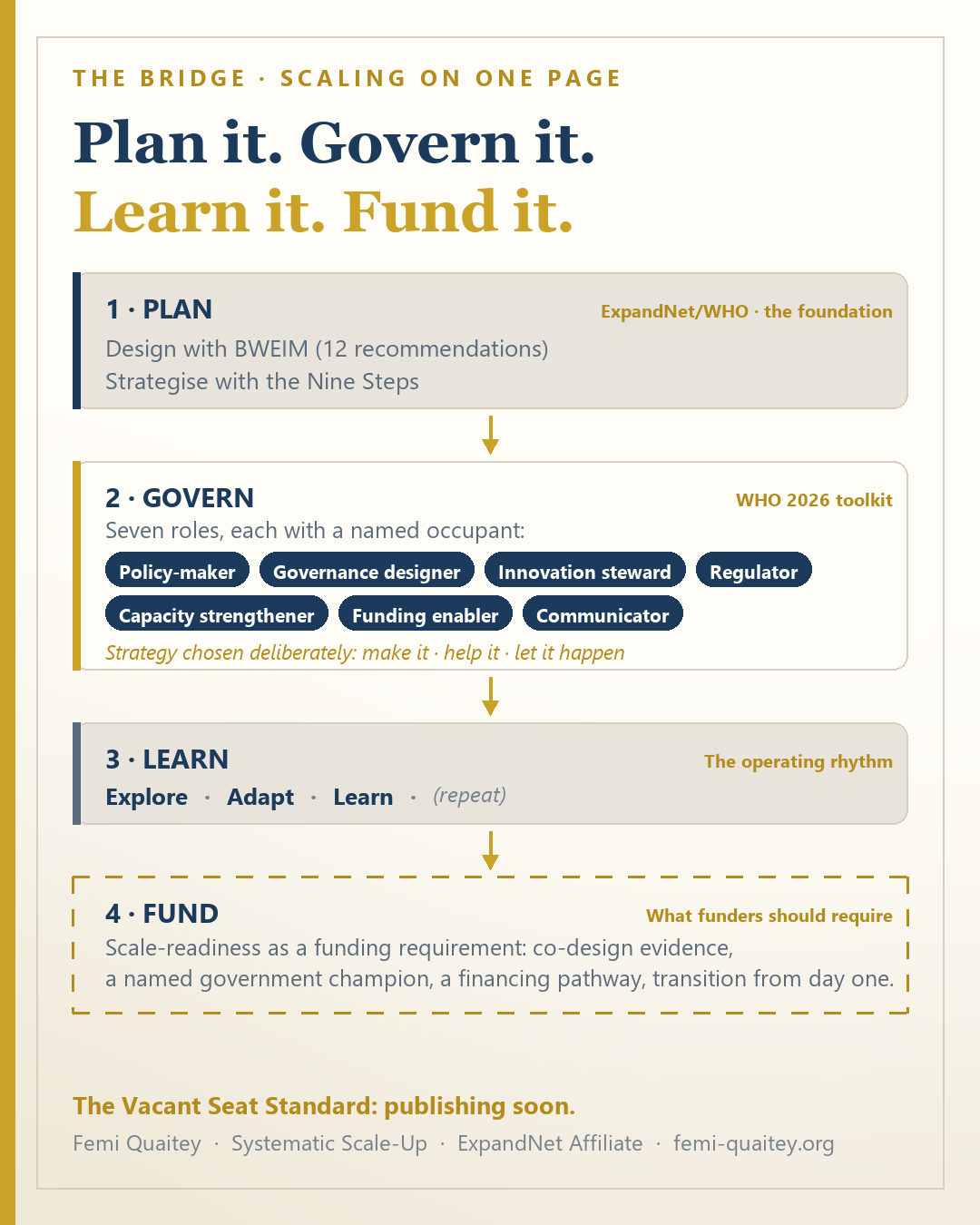
The four-layer formula for running both frameworks together, from practice, not theory.
Design the pilot with Beginning With the End In Mind (the 12 recommendations). Build the scale-up strategy with the Nine Steps. This remains the field's best planning discipline, and the 2026 guidance takes its own definition of scaling from it.
Choose the scaling strategy deliberately: make it happen, help it happen, or let it happen. Then map the seven government roles to named occupants, because when any seat is vacant, the scale-up pays for it.
Explore, adapt, learn, and repeat. Not a workshop agenda: a standing rhythm of structured exploration before adoption, deliberate adaptation to each context, and monitoring that feeds decisions rather than reports.
Both documents name the funding layer. Neither sets out what donors and governments should require at the proposal stage, before the money moves. Government co-design evidenced at proposal stage. A named government champion. A financing pathway that says which budget line absorbs which cost, by when, and what that line gives up to make room. Scale metrics from day one. Transition planning from inception. That is what The Vacant Seat Standard exists to codify.
The most common defect in stalled scale-ups is not evidence or funding. It is a role with no occupant. The policy exists, so everyone assumes the policy-maker seat is filled. But who is the innovation steward keeping partners aligned between workshops? Who is the funding enabler moving the work from donor budget to government budget line? Often, an empty chair everyone believes someone else is sitting in.
The test takes five minutes: list the seven seats and write a name behind each one. Not an institution, a name. Where you cannot write a name, you have found where the scale-up will stall, usually two budget cycles from now.
Take the seat check, free and in five minutes, and get your own seat chart with the empty chairs named.
Publishing soon: a practical, versioned standard for building scale-readiness into calls for proposals, with the five requirements, review criteria for institutional sustainability, and the red flags proposal reviewers should catch.
Written for both sides of the funding table: donors who shape RFPs, and implementing partners who answer them. Join the list and you get version 1.0 the day it publishes.
Scale is governed into existence, not piloted into existence.
What the WHO 2026 toolkit changes, what it doesn't, and the five requirements that belong in every call for proposals.
Read on LinkedIn →The seven-seat check is live now: name an occupant for each government role, and see which chair is empty.
Take the seat check →The Scale-Up Series teaches the ExpandNet/WHO framework one idea at a time, grounded in real Nigerian practice.
Watch on YouTube →